Showing posts with label Journal Entry. Show all posts

Monday, February 20, 2012

Brachytherapy

Prostate Cancer Part II
Brachytherapy (pronounced by most as 'brakie-therapy'),is a high dose targeted internal radiation. This type of treatment is used for several other cancer types as well, including breast, lung, cervical, but I will confine my discussion to the treatment of prostate cancer.
I was given the option of several different treatment types, including (1) prostatectomy, which is the surgical removal of the prostate and associated tissues, (2) external beam radiation, where low dose radiation is targeted at the cancer from the outside, which is less invasive but requires as many as 40 or more treatments, (3) hormonal, which involves the injection of certain drugs into your system to suppress the growth of male hormones that speed the cancer's growth , and (4) brachytherapy.
I chose brachytherepy for several reasons. First, it involves three treatment days separated by two week recovery periods and you are done; second, it leaves all your organs in place so at least you have a chance of them healing and resuming normal function; third, it is very targeted and specific, involving minimal damage to surrounding tissues and organs; fourth, Dr. Ray Richards comes very highly recommended by others who have had the treatment; and fifth, it just seemed like the right thing to do.
Dr. Ray Richards, Radiation Oncologist
My treatments began on January 19th with a 6:00am arrival at the Coral Desert Surgical Center in St. George. Starting about 24 hours prior you have to go through a prep procedure which involves taking a stool softener in the morning, then after a normal lunch begin fasting. You are allowed clear liquids until midnight and after that only a sip of water to take any required meds. Before bed you take two Imodium and a fleets enema. First thing next morning two more Imodium. This prepares your bowels by basically stopping them so that they don't interfere with the procedure the next day.
After checking in at the surgical center you are taken to the prep area where you remove clothing and put on a gown and elastic stockings. They give you some nausea medicine, take your vitals, have you sign consent forms, put in an IV and then wait.
the 'prep' room
Around 7:00am you are taken into surgery, where you are moved onto the surgical table where you sit up while they give you a local anesthetic to numb things a little before giving you the shot in the spine to deaden your lower body. As you feel your feet start to tingle and numbness spread they lay you down and put your feet is stirrup-like apparatus so you are basically in the birthing position. To guide them in what is to follow, they put in a catheter through your penis into your bladder, position a fluoroscope over your abdomen and insert an ultrasound probe into your rectum.
I can see the ultrasound monitor as I lay there listening to the doctors plotting the procedure. The team consists of Dr. Ray Richards, radiation oncologist, Dr Greg Taylor, urologist, a couple of nurses and of course the Anesthesiologist. You know they are doing things to you but it is rather detached, almost like it is someone else because you can feel nothing. It is a little errie watching the monitor and seeing the catheters slowly being inserted, knowing that they are invading your body. It is good that you are convinced it will help, but just the same there is nothing you can do except perhaps scream. Instead I tell the doctors I am doing fine.
They place a template on the perineum between your scrotum and anus. Through this template they insert 18 thin plastic catheters into the prostate gland as pre-determined by computer analysis using the biopsy to determine where to place each one. When this is done a CAT scan assures that they are in the correct position, and you are ready to be 'illuminated'.

the afterloader
nurse Tyler connecting the afterloader
After a short wait you are wheeled into the lead-lined room, and connected to a machine called an afterloader. Each of the 18 catheters is connected to a corresponding port on the afterloader. This machine contains a single highly radioactive iridium pellet at the end of a wire. The pellet is pushed into each of the catheters one by one under computer control. The computer controls how long the pellet stays in each catheter (dwell time), and where along the catheter it should pause to release its radiation (dwell positions). This very precise treatment takes around 20 minutes, after which you are taken to a recovery room for a five hour wait.
During the five hour recovery you can read, watch dvds, visit eat or sleep. After the rest they take you back and hook you to the afterloader again and repeat the treatment. When this is finished they remove the 18 catheters from your prostate and the one from your bladder. They make sure that you are passing urine and that there are no blood clots, and that the bleeding has stopped, then put a diaper on you and help you get dressed. Then they walk you to your vehicle and send you home. The entire event has lasted between eight and nine hours.

Friday, February 17, 2012

Join The Club

I recently joined a new club. It isn't all that exclusive, in fact membership is in the millions worldwide. It isn't even a club that one seeks to join, but rather would avoid. Even so, membership isn't free, in fact is is rather costly. Sometimes it costs your life. Obviously I didn't join voluntarily, rather I was inducted.

If you haven't guessed by now, the club is called The Cancer Club. So you now see why it is not a coveted nor sought after membership. I belong to the Prostate Cancer Chapter. I didn't want to join, and now my main membership goal is to get the certification as "Survivor". I have been reading some statistics which may be of interest:

  • About 11.7 Million Americans currently have or have had cancer (does not include skin cancer and other basil or squamous cell types)
  • About 1.5 million cases were reported in 2011, not including the above exclusions
  • Approximately 572,000 people died of cancer in 2011, 0r about 1500 per day, accounting for about 1 of every 4 deaths in the US, and exceed only by heart disease.
  • Death rates for common types of cancer in the us in 2003-7 per 100,000 were: All types-380.8; Lung/bronchus-101.4; Colon/rectal-36.1; Prostate-24.7; Breast-24; Pancreas-21.7; Non Hodgkin's Lymphoma-14.2; Leukemia-10; Liver-9; stomach-5.
  • Survival rate for all types was up from 50% from 1975-77 to 68% from 1999-2006
  • The National Institutes of Health estimates overall costs of cancer in 2010 at $263.8 billion
  • 2011 US estimates for prostate cancer, 240,540 new cases, 33,720 deaths
  • Prostate cancer is the most frequently diagnosed cancer in men and the second leading cause of cancer death
  • Relative survival rates for treated Prostate Cancer: 5 year 99.6%; 10 year 95%; 15 year 82%.

So you see from these statistics that it is a large, expensive club. My chapter has good survival rates but because there are so many cases there is still a fairly high death rate. You also see I have a pretty good chance of surviving for at least 15 more years and by then other risk factors will probably be at least as significant.

My cancer was detected pretty early. I have been having yearly PSA blood screenings done for the past 10+ years, which showed only a gradual yearly increase until this past year where it spiked 1.4 points. Anything over an annual spike of 1.0 is a danger sign. Combined with other risk factors (family history) and symptoms the urologist recommended a biopsy. The biopsy performed in December revealed a malignancy in 6 out of 11 samples taken, with a Gleason score of 6/7. The Gleason score ranges from 2 to 10, 2 being non-aggressive and 10 being very aggressive.

Because of my Dad's experience with prostate surgery, I rejected that option outright and after further consultation decided on brachytherepy, which is a high dose radiation treatment delivered via radioactive wire inserted in needles directly to the prostate. My next blog will describe my treatments, which may be rather graphic and not suitable for women and children so beware!

Monday, November 22, 2010

The Haircut

I recently was released as Young Mens President in our ward and called to work with the Young Single Adult second stake in Cedar City. I am the Stake Executive Secretary. Our Stake President has cancer and has been undergoing chemotherapy and consequently lost his hair. The rest of the presidency decided we would get sympathy haircuts for Stake conference.


Clay says I look like a very stern Steven Covey in this photo

I had never shaved my head before, so I was a little anxious about how it would look. I had several accidents while growing up and I thought there may be some ugly scars. As it turned out the scars have all faded and it didn't look too bad.

This is my Jessie Ventura look
I got the camera out to record this for posterity. It may be the only time it happens, unless I get cancer or go bald naturally. I really liked the "maintenance free" aspect. Every morning I got up without a hair out of place!

This is my favorite photo
Elma Lynne thought the whole idea was a little crazy, but in the end she helped me do it. She didn't like it much at first, but got used to it. As it started to grow in, she even commented that she kind of liked it short.
Is that you Spock?
I got a little creative with the paint program and thought I could probably get a job as a double on Star Trek. What do you think?


Thursday, June 10, 2010

Hole In The Rock, Youth Conference 2010

In the late 1870's church leaders called a group of extraordinary Southern Utah residents to pack up their belongings and move across the Colorado River and establish a settlement. It was to be a buffer between the colonized settlements in Utah and the Indians, outlaws and ruffians who were gathering to this lawless area. It was known as the San Juan Mission.

Many of these pioneers came from Cedar City, Parowan, and even Kanarraville and New Harmony. It was a daunting chore, made even more so by the fact that this was the last area in the lower 48 states to be explored and mapped. The route that was chosen required them to blast and chisel their way through a gap in the rocks on the edge of the Colorado River Gorge in what is now Garfield County. The continued on, when most thought it was impossible. Jens Nielson, a Swedish immigrant who nearly lost his feet crossing the plains with the Willey Handcart Company, is quoted to have said, "We mus go troo, even if we can not!" Then he added, "Vhat ve need now is stickity tooty!"

Our Stake leaders decided that these great pioneers could serve as an example to our youth , and selected an expedition to the Hole In The Rock as our youth conference. We met at the Stake Center on Thursday, June 3rd at 8:00 am and from there proceeded across Cedar Mountain to the rest area at The Pines near Bryce Canyon. We ended up with around 270 youth and leaders. After a brief history break we continued on to the town of Escalante, where we had lunch on the park and a presentation by a history buff named Roundy.


Lunch on the park in Escalante

Just out of Escalante you are on dirt road. It seemed like forever.

We finally arrived at our camp site, 40 mile wash. the boys camped by a cow camp and the girls camped a little to the north down in the wash. Did I mention the wind? I don't think it stopped blowing the entire trip.
After setting up camp we joined a group of youth from the Blanding Stake for an activity at nearby "Dance Hall Rock". A couple of girls played the fiddle and many enjoyed the pioneer dance we had practiced earlier in the year.
Our group photo at "Dance Hall Rock"

Stake leaders prepared Dutch Oven potatoes and pork, with salad and brownies for supper.
Friday morning was about 15 more miles of dirt road, then a four mile hike and we arrived at the "Hole".
It now seems impossible that around 80 wagons were taken through this slot, not to mention some 250 men, women and children and around 1500 head of livestock.
Erosion has taken its toll over the years, and now it is even a little difficult to hike.
This is known as "Uncle Ben's dugway", where the road was built up using Juniper posts and brush to the level of the track you see here that was chiseled out of the side of the rock.
Lake Powell makes the journey to water somewhat shorter than it was in 1879. The kids were told not to swim, and can you believe it, most of them obeyed!
The trip back to our camp was interesting and colorful, yet dusty, hot and bumpy. When we got back to the truck the thermometer read 95 degrees.

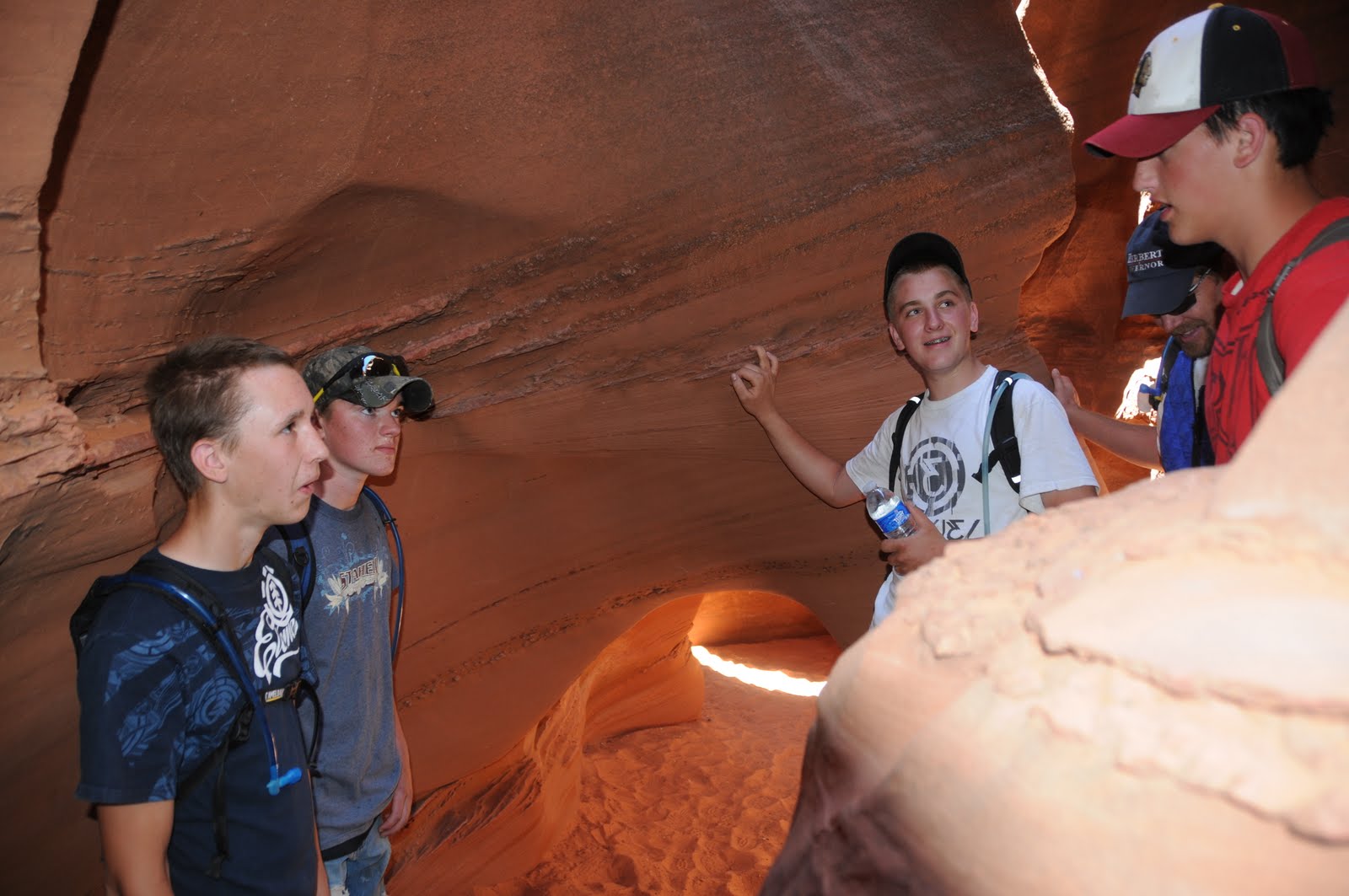
Saturday on the way home we stopped at the Dry Fork trail head and hiked some slot canyons there. In this photo we are hiking down into the Dry Fork wash.
Here we are hiking the Dry Fork Narrows.
A rest stop while trying to decide if we are in the right canyon. As it turned out, we weren't. so we went back down and started over.
Hiking back to the main wash. Fifty Mile Ridge is in the background.
After hiking the wrong slot first, we were short on water to finish the hike so some of the boys went back to the truck to get more, then went on to find "Spooky", a short, but very narrow slot canyon.
After hiking up Spooky we cut cross country about a half-mile to Peek-a-boo, another short slot canyon.
Nearing the exit of Peek-a-boo.
Making our way out of Peek-a-boo canyon.
Hiking out of the Dry fork wash back to the trucks at the trail head. Upon arrival there the temperature read 99 degrees.
Back in Escalante we enjoyed sandwiches, drinks and frozen yogurt at Subway. It was air conditioned, and heavenly! the Bishop's truck broke down coming home over Cedar Mountain, but that was the only fatality on the trip. Other than a little heat exhaustion and a few cuts and scrapes we were in good shape, and very appreciative of those great pioneers.

Saturday, October 24, 2009

The Mill Flat Fire

The Mill Flat Fire
There was a lightning strike on Pine Valley Mountain on July 25th, just north of Mill Flat. The strike started a fire which burned in rocky hillside area. Forest Service personnel were quick to observe the fire, but determined to let it burn as it seemed to pose no threat and might actually do some good by removing old growth and making way for new.
The smoke plume was visible from New Harmony and when I first spotted it I thought the fire was probably either in Main Canyon or Dam Canyon. It burned for nearly a month without spreading to more than a few acres. On Wednesday, August 26, the Forest Service had a public meeting in new harmony and informed residents that they were allowing the fire to burn based on wilderness area guidelines, and that it was being closely monitored. We were informed that if the fire reached certain predetermined lines, they would begin suppression efforts.
The very next day the fire began to spread north into the Straight Canyon area and a helicopter was called in to drop some water. The fire increased in size the following day but still appeared to be no threat. On Saturday, August 29, the fire increased in size and smoke filled the Harmony Valley. Around mid afternoon, the smoke began to lift as conditions created a 'column', and you could see that the fire had spread north of Straight Canyon and was turning back south toward Dam canyon. I went up on Little Mountain to get a better view, and was soon joined by Forest Service personnel who were now becoming quite concerned.I still wasn't too concerned for our own safety, as the fire was a long way from town. As we watched, I commented that I would start to be concerned when it came over Lawson Hill. In less than an hour it was coming over the hill, and as the evening breeze started to blow off the mountain the fire began racing north into the west side of town, threatening several homes and structures.
It was quite a helpless feeling as we watched the fire come closer and closer. We rigged up all our hoses and put sprinklers around the house and on the roof. We loaded a few emergency things and photo albums into the car just in case, still not thinking it would really get to us.

Fire crews were arriving from all over to help. A fire truck and crew from Santa Clara came and prepared to defend our home. They stated that the home itself was very defensible, but that my shop would probably not be due to all the vegetation so close by. I responded that they should forget about the shop and use all their efforts to save the house if it came to that. I moved all the vehicles down into the hay field and went back to my post on Little Mountain.

The fire burned through Gordon Pace's stockyard and haystack on its way north, which is about a quarter mile from our home. It seemed a lot closer when all you could see was a wall of smoke and fire.
As darkness came we watched the fire rage across the west side of town and the inferno consume everything in its path. We sorrowed for the property owners as we watched in morbid fascination as the flames erupted in gold, orange, red and yellow, and an occasional explosion would send sparks and flame shooting high into the air. There was a surreal beauty about what was happening, in spite of the destruction, particularly as a tree would ignite and send flames high into the night sky. We watched the fire until around midnight and by then it had calmed down with just a few hot spots occasionally flaring up.
Sunday morning the fire was relatively calm, but crews were working as soon as planes could fly, knowing that the heat of the day would bring it back to life. The main part of the fire was now burning high on the Long Ridge, burning to the south away from us. Church was called off so we watch from Little Mountain most of the day as the bombers dropped retardant and the helicopters dropped water. It was quite fascinating to watch them fill up at our neighbor's pond and fly right over our heads back to the fire.
The fire truck and crew had remained stationed at our house, though they were now from Hurricane. They seemed quite bored with their duty, wanting to be where the action was. Elma Lynne offered to let them pull weeds but they declined. I met a photographer from the Deseret News named Scott Winterton. He had made it into town before the road was closed and didn't want to leave because he wouldn't be able to get back in. We fed him a couple of meals and let him sleep in a guest room which was preferable to sleeping in his car.
The fire stayed fairly high on the mountain all day Sunday yet as the day warmed up it moved across the steep slopes south of us. At dark it died down again and didn't seem to be going anywhere, and about 9:30 pm we headed for Dad's house. We noticed that our fire truck and crew were gone, which caused a little concern but not too much as the fire seemed to be down for the night. I went out by the cemetery and watched until around midnight and the fire seemed quite benign so we went to bed at Dad's house to be company for Donna while Dad is in rehab in Saint George.
Around 2:00 am we were awakened by sirens and I went out to the corner and looked toward our home to see the fire had moved down the mountain and was literally at the back of Little Mountain which was glowing like a football stadium under full lights.

I quickly dressed and hurried to our home and upon arrival there realized the fire was way too close for comfort. I called Elma Lynne and told her that if she wanted anything else out of the house she better come and get it. There was a search and rescue man knocking on our door to tell us to get out, so I relayed the message to Scott who was sleeping peacefully. Then I headed for Little Mountain to get a good view of what was happening. On the way there I ran into a Forrest Service truck and the driver said he was lost. I told him how to get back to town, and asked him to get me a fire truck if he possibly could. Within twenty minutes we had two fire trucks and about thirty Hot shots on site.
As we watched from Little Mountain the wind calmed down and the fire stopped its advance around 4:00am. At this point they decided to do a back-burn from the fire line along the forest boundary, and soon the night sky was again vivid with fire, but this time it was burning away from us. As daylight came the fire near us was pretty well controlled and we had a pretty good fire break just in case it decided to turn back.

Hot Shot crews maintained the fire break most of the day, and by evening we felt that the threat was past for us. They continued to work for another few days, with crews and planes concentrating on areas high on the mountain.

Cooler weather helped and by the following Sunday the fire was declared 100% contained and the crews began to move out. As we looked at the smoldering heap the used to be Pine Valley Mountain, our hearts are sick for the loss.

In the final assessment the fire burned an estimated 12,607 acres and cost $6.2 million to put out. At the high point there were 765 personnel including seven Hotshot crews, 11 type two crews, 10 helicopters, 2 fixed wing aircraft, 35 engines, 2 dozers, and 8 water tenders. The support staff and logistics and organization of such an operation are staggering, and it was amazing to see how quickly they assembled this team.
I think most everyone in the valley is grateful for the efforts made. It could have been much worse. Several structures and three homes were lost, one being a million dollar second home, one being an abandoned double wide and a third being an apartment type structure over a barn. Several other homes and structures were damaged, but luckily saved. Mistakes were made that could have possibly averted this tragedy, and yet I think everyone knew Pine Valley Mountain was over due for a fire. I think that most felt that since the Blue Springs Fire a few years ago had come so close, we were immune for a while, but not so.
Now it is time for healing. It will take years for the mountain to recover, perhaps even decades, but it will recover. Many of us will not be alive to see it fully happen, but we will be able to watch as life returns, the ash fades and green takes over again.

Tuesday, October 13, 2009

The Silver Beaver


The Silver Beaver Award is the highest award given in Scouting. It is awarded to those who have given extraordinary service to youth through the scouting program over a period of many years. In order to achieve this award you have to be nominated by someone in local leadership, then have your service record reviewed, then your nomination approved by the Council. It is not something you can apply for or actually work toward.


I know a few people who have recieved The Silver Beaver, but I never considered that I would be one of them. I have worked in the youth of the church most of my adult life. I have been ward Young Men's President three times, Scoutmaster two times and have probably been a merit badge counselor forever. In the councils and districts where I gave the majority of this service, recognition for adults seemed quite rare.


Three years ago when I returned to Southern Utah, my bishop submitted my name when the district asked for cantidates for the Second Miler Award, a district recognition. Joyce messer, who does all the work for the district awards interviewed me and told me I should have been, and would be recognized for my many years of service. That year I recieved the Second Miler Award, the next year I recieved the District Award of Merit, and this year I recieved the Silver Beaver Award.


The award ceremony was at the Provo Tabernacle on September 12, 2009. Ninety-six people from the Cedar Breaks Council recieved this recognition. Many of these people have worked much harder and put in more time than I have, some perhaps less, and I am sure there are many scouters out there who deserve this recognition more than I. Nonetheless, I am extreemly honored to have the award and will wear it with pride.


Governor Gary Herbert spoke at the ceremony, after which each cantidate walked to the podium with their escort (Elma Lynne) and the award was presented while a short bio was read. After exiting the stand, a photo was taken with the district scout executive.


All our kids from the area and their spouses came to the ceremony, which was an honor for me as well. After the ceremony we took the group to lunch at Olive Garden where we had a good visit before returning home.

Sunday, October 4, 2009

Time to blog again?

I have been out of the blog loop for quite a while and think it is time to get back in. A lot has happened over the past 6 months or so that I would like to get written down for my own sake, as well as to share with those who might be interested. Below is a list of things I want to record, and I think I will start with the most current and work my way back. As I do I may find other things that I want to write about, so the list isn't necessarily inclusive. If things happen in the meantime that are worth blogging about I will probably insert them while they are fresh on my mind, so things will probably get a little jumbled up, but then who cares? I promise not to editorialize or make fun of other people's blogs unless I create a new blog that is completely anonymous...


The fishing trip to Canada (9/24-28/09)

The Silver Beaver (9/12/09)

The new meadow ditch pipeline (9-09)

The Subway hike (9/3/09)

The Mill Flat fire ( 8/28-30/09)

Dad's broken hip (8/2/09)

The Kanarra Falls hike (7/11/09)

My Rose Garden (7/09)

The Spring Creek Hike (6/8/09)

Woodbadge (6/22-27/09)

The Kolob Arch Hike (5/13/09)

The Grand Canyon Hike (5/29/09)

I know the list is quite ambitious, and I may never get it done, but at least I have a goal.

Saturday, January 24, 2009

The Dance Club

It isn't really a club, its just a few folks getting together to learn and dance. Surprisingly, there are quite a few folks in this valley who really like to dance. I had thought that 'real' dancing was becoming a lost art, but perhaps not.
The VanWagners moved into the valley and offered to teach dance to anyone that wanted ot learn. Just after Christmas they had eleven couples jammed in their basement for the first session and quickly decided to move to the church. Now we are meeting every Saturday at 4:00pm. We are not only learning to dance, but we are also learning a special waltz routine for the floor show at the New Harmony Sweetheart's Ball on February 13th.


Today, January 24th, besides working on the waltz routine they taught us the basic steps of the Cha Cha. They want to also teach the Rhumba, the Two-Step and the Polka before the Ball.
Valentines is kind of special to Ellie and I. We had our first date to the Cedar High Sweetheart's Ball on February 12th, 1965. We attended the same Junior High and High School but never really knew each other until we were seniors. That year we had two classes together, and by virtue of alphabetical seating we sat by each other. The Sweetheart's Ball was girl's choice, and she just couldn't resist my charm and asked me. We were married fours years and four months later.

This is a photo of one of our first dates in 1965